

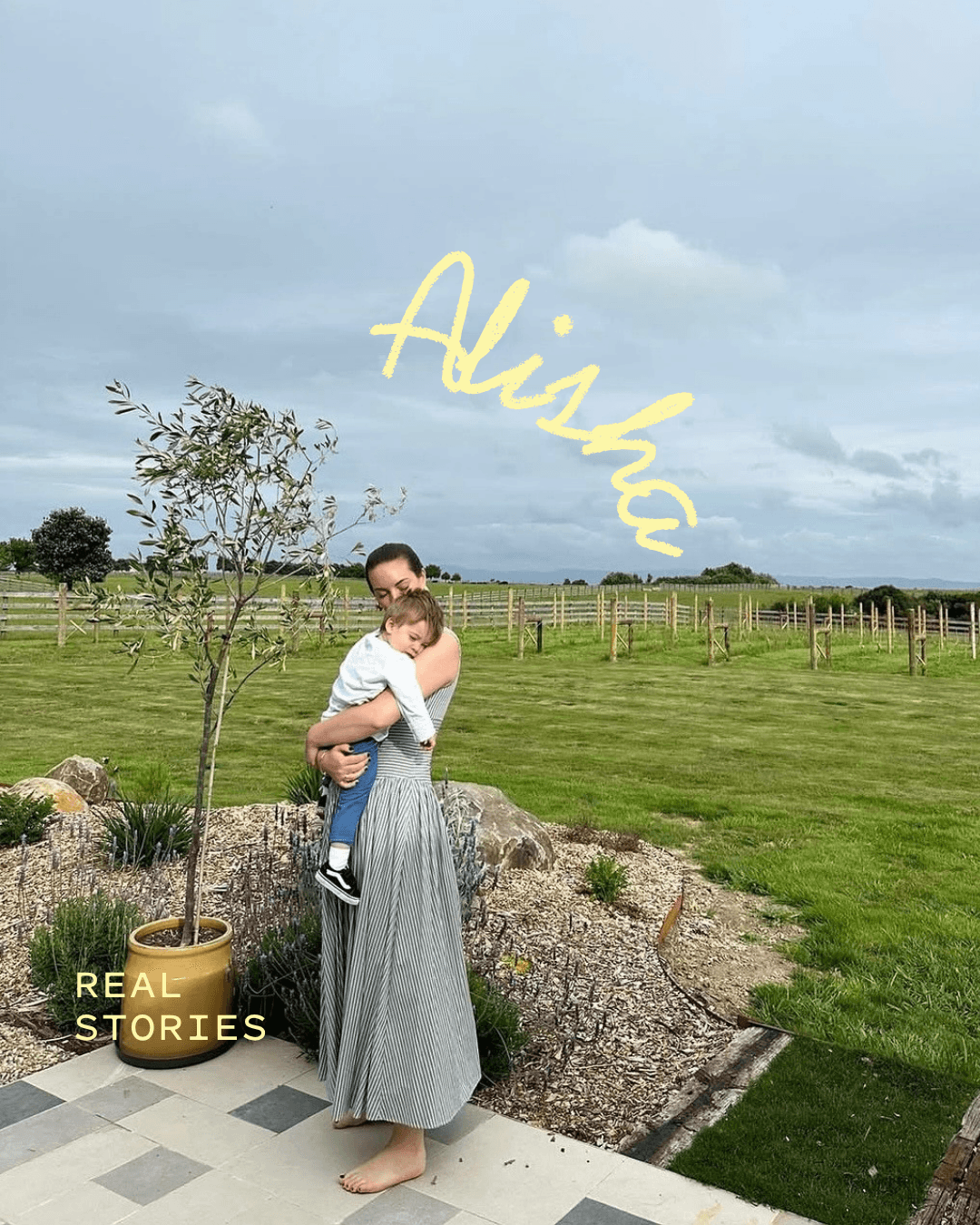
Real Stories: When period pains starts to feel like ACTUAL labour with Alisha Clark
READING TIME
5 min
Let’s start with a classic: What’s your worst, funniest, or most awkward period story?
The most awkward would have to be the first time I got my period. I was at an inter school netball tournament. I saw blood in my undies and so stuffed some toilet paper in there while feeling anxious and ignoring it for the rest of the day. I was wearing 3/4 length baby pink tights and I remember trying not to sit down properly in my friends car on the way back to school in case I marked her seat. Her mum then walked around and wrapped a jumper around my waist and said I had blood on the back on my pants and that she would walk me to mums car. I was so embarrassed at the thought of how long it has been there and how many people might have seen.
What have you demystified about your female body that you wish you knew when you were younger?
I wish I knew about my cycle earlier. I was on the pill since I was a teenager when I was first diagnosed with endometriosis until I tried for my first baby and it hasn't been until my 30s that I've really started to understand my cycle. It's such a huge part of who I am that I never had any understanding of.
Have you been diagnosed with a women’s health or gut health condition (like Endometriosis, PCOS, PMDD, IBS etc.)? If so, how did you know something wasn’t right, and what was your journey like to get answers?
Yes, I was diagnosed with endometriosis when I was a teenager after having extremely painful periods since I first got them when I was 11. I would have to take days off of school every month. I was very lucky that my mum knew something wasn't right and that I shouldn't be in that level of pain so she took me to a gynaecologist and I had my first endometriosis surgery. So my initial diagnosis was quick, however I have had severe pain since my cycle returned after my second child and that has been a very different experience.
What was your diagnosis experience like?
As I said above, my initial diagnosis as a teenager was straightforward as I remember it. However, since I started getting severe pain when my cycle returned after my second child my experience has been very different. When it returned, I started getting debilitating pain during ovulation (the first month I was unable to walk properly) and then with my period I started each month getting episodes of uterine cramping that were like-to-like comparable with active labour. However, with the episodes, unlike labour contractions that come in waves and then you get a break, these were continuous. People always say that you don't know labour is like unless you've been through it. Well, coming from someone who has had 2 unmedicated births, if you've experienced this, it is LITERALLY the same as active labour. It has been traumatising and incredible anxiety inducing. It has been accompanied by incredibly heavy bleeding (I often wake up in the night to a sensation like my waters are breaking with gushing blood and have to sit on the toilet while I bleed). I reached out to a female gynaecologist and after seeing my scans, doing an examination and hearing my clinical symptoms, told me I just have painful periods which are normal. I left in tears knowing this was so far from normal. I then dove into every corner of the internet and came across Dr Amelia Ryan on one of your podcasts. I reached out to her for a second opinion and she has been incredible. I had a surgery last week and have been diagnosed with adenomyosis. My first experience was heartbreaking though - there is a lot more I could talk about with this experience too - a lot of shocking things, such as completely incorrect clinical notes, etc.
How has your condition impacted your daily life?
What I really want to talk about are these episodes of severe uterine cramping which literally feels the same as being in active labour. It's not something I've been able to find out a lot about, not something that even my gynaecologist has heard of as being very common. It's been so hard to feel understood and for people to understand the severity. When I say it's like being in active labour, I know that sounds dramatic, but its TRULY what it is like. And I KNOW. It's hugely impacted my daily life. I am terrified of having an episode when I have my kids. I've been incredibly lucky that by some miracle I've not had a serious episode while looking after the boys. But I have nightmares of getting one in the supermarket and being curled up on the floor. There is so much anxiety and I feel like I'm unable to leave the house during my period as I get no warning as to when they are coming on.
What symptoms made you think something wasn’t right with your body?
As soon as I had an episode of the severe uterine contractions I knew this wasn't right. The first one happened in the evening and my husband was with me. I knew it wasn't right but I thought it must have been a very strange one off. When it happened the same day the following month I knew I needed help. It came on so suddenly. Within minutes I was retching like I was going to vomit from the pain and in the fetal position having to breathe through the contractions like in labour and making animalistic vocalisations like in active labour. I called my mum to talk me through it as I was struggling to stay calm and focus on my breath as I was in so much shock and pain that I kept bursting into tears and just saying "I don't understand what is happening, it's like I'm in labour". My sister lives next door and my mum sent my sister down to sit with me and rub my back and get wheat bags until it passed. I was absolutely traumatised and knew I needed to see a specialist as soon as possible. The experience as I said above with the first gynaecologist I saw was really upsetting, I wasn't listened to or taken seriously at all. She wasn't grasping the extent of my pain and because she couldn't see or feel endo said it was just a normal painful period. I knew I needed a second opinion.
Have you tried anything that has helped you manage your symptoms?
When I saw Dr Amelia Ryan, she suggested a surgery to get a clear picture of what was going on. She couldn't see any clear endo on the imaging or feel any internally so she said it's likely mild endo (which we know can still cause a lot of pain) or what she thought it would likely be is adenomyosis. I had the surgery last week and it was as she thought. However, while she said all my clinical symptoms would suggest adenomyosis, there still feels like this level of uncertainty in the diagnosis as she hasn't seen physical evidence this is what it is. I really crave to know what is truly happening and causing this. From the deep corners of the internet, it definitely seems like all my symptoms match adenomyosis, but I just wish it's something we could know for sure. The only way to definitely diagnose it is by looking at the tissue under a microscope after a hysterectomy, so we just have to live with this assuming that's the case. Dr Ryan said we will hope to manage it with hormonal treatment (I am taking a progesterone pill) as well as pain relief and a medication that reduces bleeding, then consider a hysterectomy if this hasn't properly managed symptoms after I've finished my family. I am also seeing a pelvic floor physio, a dietician around a low inflammatory diet, a number of holistic wellness practitioners and will start seeing a psychologist also - all under Amelia's recommendation for holistic pain management.
What’s one thing you wish more people understood about women’s health?
I wish more people understood the silent conditions that women live with - that we cover up so well as we are expected to show up in life like everyone else. When you have a chronic pain condition, or any women's health condition, you suffer silently, your pain isn't visible to the outside world unless you vocalise it but it impacts every area of your life.
What's the best piece of advice you've been given?
The even if we don't find endo, your pain is real and valid. Dr Ryan told me this at a time that I really needed to hear it. As women we are constantly told that we are over exaggerating, or it's assumed that we have a low pain threshold. I was literally told I must have a low pain threshold by the first gynaecologist and bless my husband, he said "She has had 2 children, one posterior, unmedicated - she can cope with pain." Another piece of advice is that the body can heal itself. This is something I truly believe and am leaning into trusting on my healing journey from this point forward.
When your body feels hard to live in, how do you take care of yourself?
I communicate what I'm experiencing to my friends and family so they know how they can best support me. I think this is the best act of self-care - helping those around you to understand what you are going through so you can accept their help and support when you need it.
If you could go back and tell younger self one thing about your body or your journey, what would it be?
It would be to learn about your body and your real cycle straight away. It's such a powerful, important part of who we are as women, that is so overlooked and covered up. Not understanding this until I was in my 30s feels like a huge loss, a huge part of me I spent so long not knowing.
Any specialists or support networks you'd recommend? Share their name or website :)
Dr Amelia Ryan.
